The Power of Language
Your Plastic Brain and the Power of Language
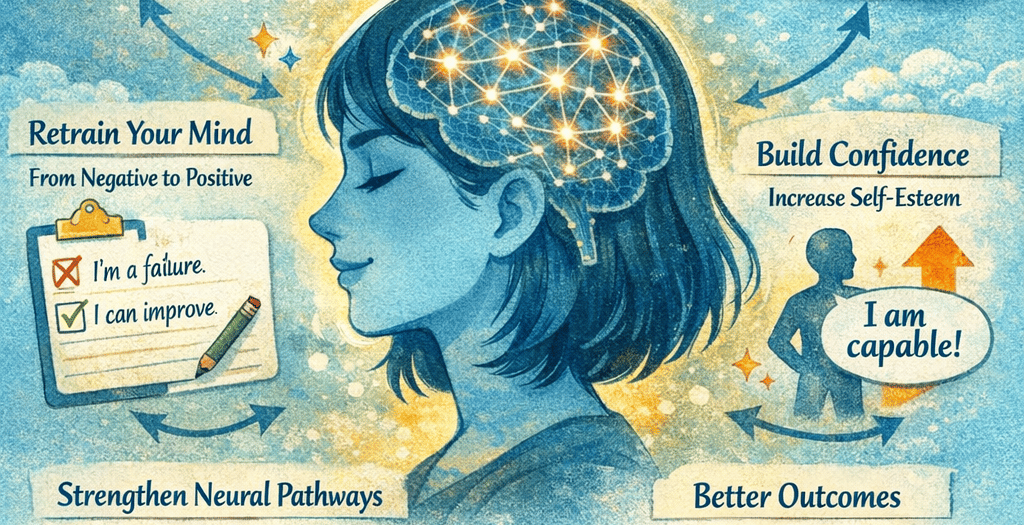
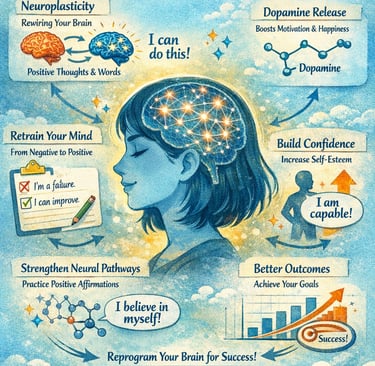
Are you aware of your internal dialogue — and the tone you use when you speak to yourself? Is it friendly or annoyed, encouraging or condescending? In other words: is your self‑talk supportive or harsh? Language is powerful. It shapes our thoughts, and our thoughts shape our actions. So how do we use that power to our advantage?
You might say, “I’m just hard on myself — I can’t help it,” or “I’ve always been a perfectionist,” or “I inherited my pessimism; my mom is the same.” But being judgmental, unforgiving, or relentlessly self‑critical comes at a high cost. It keeps you from feeling fulfilled, and it can even affect your health. And has it truly paid off? Has it made you successful — or simply exhausted?
Twenty years ago, I sabotaged myself constantly. Especially in my career. I believed every thought I had was true. I beat myself up, used cruel language, jumped to conclusions, assumed I could read minds, predicted the worst, and dismissed anything positive. Then I learned something that changed everything: your brain can change. This is the science of neuroplasticity — the brain’s ability to rewire itself. People recovering from brain injuries use it to regain function. And the rest of us can use it to change our default patterns of thinking. Confucius said, “When the root is in disorder, the branches cannot be in order.” To cultivate a better life, we must first cultivate a better mind.
In the last two decades, Confucius’s wisdom has been supported by a new scientific field: Positive Psychology. Since becoming an official academic discipline in 1998, it has shown — together with research on brain plasticity — that we can improve our well‑being, strengthen resilience, and even reduce the risk of cognitive decline. Think of it as a shortcut. Instead of digging endlessly into old wounds to understand why you’re so hard on yourself, science now offers gentler, more effective tools for healing and growth. Struggle may build character, but if you can improve your life without agony, why wouldn’t you?
Dr. Martin Seligman’s PERMA model (Positive Emotion, Engagement, Relationships, Meaning, Accomplishment), Dr. Barbara Fredrickson’s 3‑to‑1 positivity ratio, Angela Duckworth’s research on grit, and Dr. Michael Merzenich’s work on brain plasticity all point to the same truth: You can train your brain to work for you, not against you.
So how do you begin?
You cultivate determination, perspective, courage, flexibility, resilience, stamina, and confidence. And the foundation of all these skills is language — the way you speak to yourself.
Use words that encourage perseverance. Praise your effort, not your identity. Surround yourself with people who work steadily toward meaningful goals. See difficulties as opportunities to learn, not as proof that you’re failing. Give yourself a sense of purpose, even if it feels small. Short‑term goals keep you motivated and moving forward.
The physiology of the brain changes when new neural connections form. Each time you practice a new skill or a new way of thinking, you strengthen the pathways that support it — and weaken the ones you don’t use. Over time, your brain decides which patterns to keep.
So when you make a mistake, instead of saying, “God, I’m such a loser,” try, “I gave it an honest try,” and try again. According to Angela Duckworth, grit — passion plus perseverance for a meaningful goal — is the hallmark of high achievers in every field. And grit can grow.
Thoughts can catapult you toward success or quietly sabotage you. Success is 90% attitude and 10% hard work.
If your mother has a pessimistic outlook, you don’t have to inherit it. If you’ve been a perfectionist forever, you don’t have to stay one — unless you choose to. Your brain is plastic. You can mold it.
Catch your inner dialogue. Redirect it. Build new connections.
Have a plastious day.
Wilma Wever, Performance EmPowering